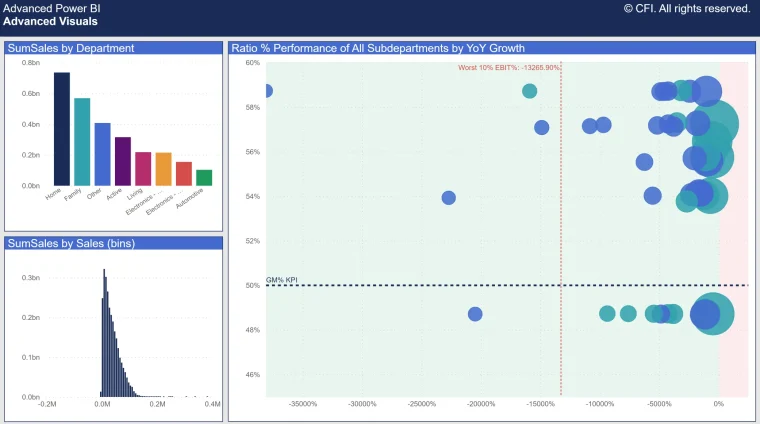
This course equips participants with the knowledge and practical skills required to use Business Intelligence (BI) tools and software for financial analysis, reporting, and decision-making. It focuses on financial data modeling, dashboards, visualization, forecasting, and performance tracking using modern BI platforms. Participants will learn how to transform financial data into actionable insights that support budgeting, planning, and strategic financial management.
Target Groups
- Finance professionals and accountants
- Financial analysts and auditors
- Business intelligence and data analysts
- Investment and banking professionals
- Budgeting and planning officers
- Students pursuing finance, accounting, or data analytics
Course Objectives
By the end of this course, participants will be able to:
- Understand the role of BI tools in financial management.
- Use BI software for financial reporting and analysis.
- Build financial dashboards and performance reports.
- Analyze revenue, costs, and profitability trends.
- Integrate financial data from multiple sources.
- Apply data visualization techniques for finance.
- Support budgeting and forecasting processes.
- Improve financial decision-making using BI insights.
- Optimize financial performance tracking systems.
- Communicate financial insights effectively to stakeholders.
Course Modules
Module 1: Introduction to BI in Finance
- Overview of Business Intelligence in financial management
- Role of BI in decision-making
- Financial data types and sources
- BI lifecycle in finance
- Case studies in financial analytics
Module 2: Overview of BI Tools & Platforms
- Introduction to popular BI tools (Tableau, Power BI, etc.)
- Features and capabilities of BI software
- Selecting BI tools for finance
- Cloud vs on-premise BI solutions
- Integration with financial systems
Module 3: Financial Data Preparation & Modeling
- Data collection from financial systems
- Data cleaning and transformation
- Financial data modeling techniques
- Structuring datasets for analysis
- Building financial data models
Module 4: Financial Reporting with BI Tools
- Designing financial reports
- Profit and loss analysis dashboards
- Balance sheet visualization
- Cash flow reporting
- Automated financial reporting systems
Module 5: Data Visualization for Finance
- Principles of financial data visualization
- Charts for financial analysis (trends, variance, KPIs)
- Interactive dashboards for finance teams
- Visual storytelling with financial data
- Best practices in financial visualization
Module 6: Budgeting & Forecasting Analytics
- Budget tracking and variance analysis
- Forecasting financial performance
- Scenario analysis and modeling
- Trend analysis using BI tools
- Supporting financial planning processes
Module 7: Performance Measurement & KPIs
- Key financial performance indicators (KPIs)
- Revenue, cost, and profitability analysis
- Financial ratio analysis
- Monitoring financial health
- Executive dashboards for decision-making
Module 8: Advanced BI Features for Finance
- Drill-down and data exploration techniques
- DAX and advanced calculations (Power BI)
- Calculated fields in BI tools
- Predictive analytics in finance
- Real-time financial monitoring
Module 9: BI Integration with Financial Systems
- Integrating BI with ERP systems
- Connecting databases and spreadsheets
- Automating financial data pipelines
- Data security and governance in finance
- Ensuring data accuracy and consistency
Module 10: Capstone Project & Case Studies
- Real-world financial BI scenarios
- Group project: building a financial dashboard
- Financial analysis and reporting exercises
- Presentation of insights and recommendations
- Emerging trends in BI for financial management