




Start Now

+254722784250
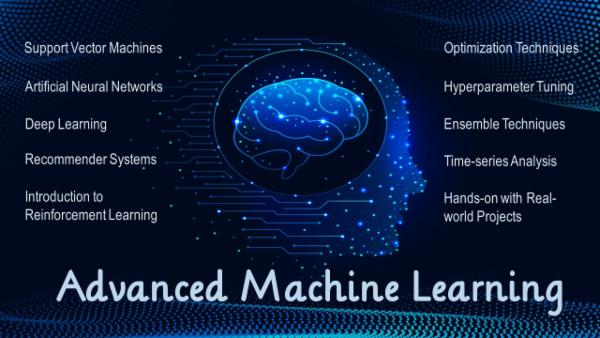
This course provides an in-depth exploration of advanced machine learning (ML) techniques for professionals aiming to enhance their expertise in data-driven decision-making and predictive analytics. It covers cutting-edge supervised and unsupervised learning methods, deep learning architectures, reinforcement learning, natural language processing (NLP), and advanced model optimization techniques. Participants will also gain hands-on experience in applying ML techniques to real-world problems using modern tools and frameworks.
By the end of this course, participants will be able to:
Module 1: Advanced Supervised Learning Techniques
Module 2: Advanced Unsupervised Learning
Module 3: Neural Networks and Deep Learning
Module 4: Reinforcement Learning (RL)
Module 5: Natural Language Processing (NLP)
Module 6: Model Optimization and Hyperparameter Tuning
Module 7: Model Evaluation and Explainability
Module 8: ML in Production
Module 9: Emerging Trends in Machine Learning
Module 10: Capstone Project and Case Studies
We use cookies to improve your experience, including essential cookies required for the website to function. By continuing, you agree to our use of cookies.
We use cookies to help you navigate efficiently and perform certain functions. You will find detailed information about all cookies under each consent category below.
Necessary cookies are required to enable the basic features of this site, such as providing secure log-in or adjusting your consent preferences. These cookies do not store any personally identifiable data.
Analytical cookies are used to understand how visitors interact with the website. These cookies help provide information on metrics such as the number of visitors, bounce rate, traffic source, etc.
Advertisement cookies are used to provide visitors with customised advertisements based on the pages you visited previously and to analyse the effectiveness of the ad campaigns.
Functional cookies help perform certain functionalities like sharing the content of the website on social media platforms, collecting feedback, and other third-party features.
We use cookies to improve your experience, including essential cookies required for the website to function. By continuing, you agree to our use of cookies.
We use cookies to help you navigate efficiently and perform certain functions. You will find detailed information about all cookies under each consent category below.
Necessary cookies are required to enable the basic features of this site, such as providing secure log-in or adjusting your consent preferences. These cookies do not store any personally identifiable data.
Analytical cookies are used to understand how visitors interact with the website. These cookies help provide information on metrics such as the number of visitors, bounce rate, traffic source, etc.
Advertisement cookies are used to provide visitors with customised advertisements based on the pages you visited previously and to analyse the effectiveness of the ad campaigns.
Functional cookies help perform certain functionalities like sharing the content of the website on social media platforms, collecting feedback, and other third-party features.